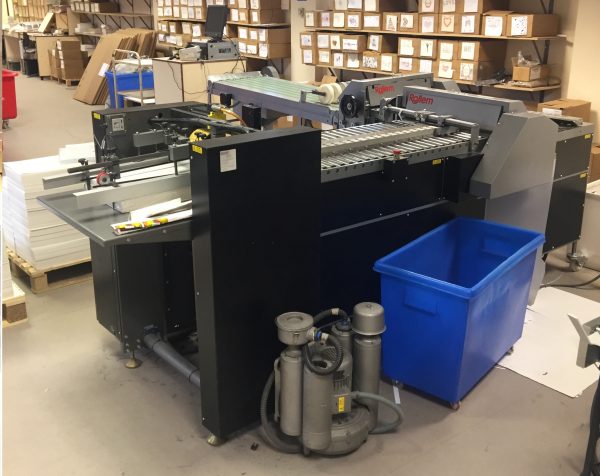
Rollem attending BPIF and CDI Yorkshire event on Yorkshire Day

Rollem will be attending The BPIF (British Print Industries Federation) and CDi Yorkshire (Creative Digital Industries Yorkshire) brings you the celebrations of Yorkshire Day on the Monday 1st August 2016 (12pm – 2pm) at the Oracle Bar, Leeds. This event will celebrate the regional success of the creative, digital and print industry.

Ian Bennett, Master of the Worshipful Company of Stationers and Newspaper Makers will be in attendance.

The day will include a presentation by Stefan Casey, Business Innovation Manager at The Retail Institute, Leeds Beckett University on Sensory Marketing, followed by networking food and drinks.

In this inaugural year of the Victor Watson Trophy we will recognise the young people who have made such outstanding achievements in our industry.

Programme

12:00 – Arrival

12:10 – Welcome by Robert McClements, Chief Exective at CDi Yorkshire

12:20 – Presentation by Stefan Casey, Business Innovation Manager at The Retail Institute on Sensory Marketing

Presentation outline:

The journey to creating a multisensory consumer experience.

Sensory Marketing and experiences are at the top of most organisations wish lists. Whether you are a brand, a retailer, manufacturer or agency understanding how to deploy Sensory Marketing through print and packaging is now becoming much sought after.

It’s opening up opportunities for those organisations who are embracing Sensory Marketing into their product portfolio to engage directly with the Brands and Retailers in a completely new and different dialogue that transcends disciplines.

Stefan Casey from the Retail Institute at Leeds Beckett University will share some insights into the world of multi-sensory marketing and experiences. Taken from their much in demand Sensory Knowledge Infusion Workshops*, Stefan will explore what it means for print and packaging, more importantly, the opportunities it’s creating.

He will open up your eyes and explore examples of how sensory marketing creates an emotional experience and consumer resonance with a Brand that can last a lifetime. Stefan will touch upon some of the considerations needed to create a true sensory experience for print, packaging and beyond;

Why sensory marketing?

Sensory best practice tips.

Sensation versus perception.

Where next?

12:50 – Networking food and drinks

14:00 – Close

If you would like to register your attendance please email [email protected]

Rollem launches new AutoPunch at Drupa 2016

The new Rollem AutoPunch can be used in line or hand fed. It has a small footprint and provides a strong, reliable and quality punch.  

The Rollem AutoPunch can be used for applications such as playing or trading cards and business cards.

Key features:

  • Up to 210 x 150mm (A5) sheet size
  • Maximum 50 decks per minute
  • Stock weights up to 700gsm
  • Die punch paper, card and plastic
  • Air pressure 95psi
  • Integrates with Rollem finishing machines along with wrapping and boxing
  • Die’s are available in a range of sizes and we offer a re-sharpening service on request

Visit Drupa in Hall 10, stand B10-1 to talk to our engineers about the AutoPunch and see a demonstration.


Rollem product demonstrations at Drupa 2016 show

From 31st May to 10 June 2016 in Dusseldorf, Drupa 2016 is the world’s leading trade fair for print and cross-media solutions

Rollem will be demonstrating a range of new products at Drupa 2016 which will expand Rollem’s capability for print finishing across a wider range of applications.

Rollem will be exhibiting throughout the exhibition as part of the UK PICON pavilion on stand number 10B10-1 in Hall 10 including product demonstrations and a chance to discuss your print finishing issues with the team of Rollem engineers.

There will be product demonstrations every day on the stand showcasing print finishing solutions that will increase your production efficiency and reduce your costs.  These will include:

10.30am everyday
Playing cards on our JetSlit system showing the
slit, cut, collate, punch and wrapped in one pass

3.30pm everyday
Mailings/transactionals on our Advantage system showing
perforate and folding in one pass.

Visit our stand to see the systems running and talk to our engineers about how a system could be tailored to your requirements.

To find out more and book your place:

http://www.drupa.com/

Some examples of the equipment we will have on display at the show include the JetStream running playing cards and the JetSlit running laminated business cards.

View a video of the JetSlit here

View a video of the Advantage here

Rollem attending Packaging Innovations 2016

Rollem will be attending the Packaging Innovations 2016 show at the NEC in Birmingham on Wednesday 24th February 2016.

To arrange a meeting with Managing Director, Stuart Murphy at the show please email [email protected] or call 01226 745476.

Rollem’s print finishing experience ranges from business cards to packaging, offering solutions to cut, perforate, fold, slit and collate in one pass.  To find out more about our bespoke systems http://www.rollem.co.uk/products/rollem-products/

To book your free place to attend please click here

Rollem exhibiting at Drupa 2016

From 31st May to 10 June 2016 in Dusseldorf, Drupa 2016 is the world’s leading trade fair for print and cross-media solutions.

Rollem will be exhibiting throughout the exhibition as part of the UK PICON pavilion in Hall 10 including product demonstrations and a chance to discuss your print finishing issues with the team of Rollem engineers.

Further details to follow.

http://www.drupa.com/

Rollem launches A3 to A6 automatic size change capability

This new version of the JetStream means that we can feed SRA3 size sheets in and automatically change between, A3, A4, A5, A6 and business card size finished product without stopping the Rollem finishing system.  

By using a bar code reader to read each sheet the Rollem JetStream system identifies and adjusts for the cuts for the right size of sheet each time.

Key features:

  • Up to SRA3 sheet size
  • Automatic size change – cuts to A3, A4, A5, A6 and or business card size
  • Up to 3,000 or 4,000 sheets per hour
  • Stock weights up to 700gsm
  • Suction feeder – reliable single sheet feed
  • 1.6mm gutter slit – minimising waste

To find out more contact Stuart on email [email protected] or call +44 (0) 1226 745476

Rollem launches A3 to A6 automatic size change capability

This new version of the JetStream means that we can feed SRA3 size sheets in and automatically change between, A3, A4, A5, A6 and business card size finished product without stopping the Rollem finishing system.  

By using a bar code reader to read each sheet the Rollem JetStream system identifies and adjusts for the cuts for the right size of sheet each time.

Key features:

  • Up to SRA3 sheet size
  • Automatic size change – cuts to A3, A4, A5, A6 and or business card size
  • Up to 3,000 or 4,000 sheets per hour
  • Stock weights up to 700gsm
  • Suction feeder – reliable single sheet feed
  • 1.6mm gutter slit – minimising waste

Merry Christmas and a Happy New Year from all at Rollem

We will be closed for Christmas on afternoon of Friday 18th December and then from 1pm on Christmas Eve (24th December), back open from Monday 4th January 2016 from 8am.

Wishing everyone a Merry Christmas and a Happy and Prosperous New Year for 2016 from all at Rollem.

Superior invests in a new rollem b1 jetstream

One of the UK’s most rapidly expanding and successful design, print and fulfilment companies has ordered a B1 JetStream from Barnsley based Rollem.

Superior currently produces significant volumes of shelf cards of various sizes for Point of Sale (POS) kits, under extremely tight deadlines, for major retail brands.  Using their current processes a large amount of their POS material is creased, die-cut, guillotined and collated requiring 3 different machines to produce this work.

Having visited IPEX at the London Excel Centre, Superior viewed a Rollem designed and manufactured, Slipstream MKII which was demonstrating cutting and collating of playing cards.  As a result of this, Superior approached Rollem about designing a machine that was capable of producing a similar result for a range of shelf edge cards.

The equipment will enable Superior to produce shelf edge labels from B1 paper stock up to 400gsm at up to 1,000 sheets per hour in one pass.

The system will include Rollem’s newly developed suction feeder which offers a more consistent feed and has capability of running a heavier stock up to 700gsm to a high quality standard. The new suction feeder has cups that pick up the stock rather than relying on friction from the drum which can skid on the feed.

Rollem export 80% of their work and Managing Director, Stuart Murphy said “we are pleased to be able to work with Superior to tailor this system to meet their needs which will enable them to increase their production capability.”

From flat sheets, the Rollem B1 JetStream machine is capable of cutting, creasing and collating in one process, which has resulted in a significant reduction in both production times and waste which is important as it is in line with Superior’s environmental policy.

Following delivery by the end of October, one of Rollem’s engineering team will go to site to install and carry out operator and service training over a period of 8 days.

Richard Blueitt, Operations Director, Superior said “We have, for several years, been actively seeking a machine that is capable of producing this type of work faster and more efficiently.  After many meetings and discussions with the development team at Rollem, we are pleased to announce the installation of our new Rollem B1 JetStream. This has been an exciting project and we look forward to working with Rollem in the future.”

To see the B1 JetStream in action please view the video here https://www.youtube.com/watch?v=2KvE4LBG_yY

Digital Age Opening up Markets for Rollem

Exports account for 95 per cent of print finishing equipment experts Rollem’s sales.

The United States is the company’s biggest market, but the company also exports all over Europe and is seeing interest from Canada and the Middle East.

It is also open to applications outside the printing sector, in food, horticulture and construction, for example.

“We get some off-the-wall requests,” says managing director Stuart Murphy.

The company has been approached by a Greek company that makes sheets of plastic pots that are filled with seedlings to make a perforator that would allow garden shop customers to tear off as many or as few individual pots as they want.

There is a company in France that makes sheets of communion wafers and needs a machine to cut them into individual squares or punch them into circles.

And there was a medical supplies company that wanted a machine to cut labels out of a special material that would then be stuck on to surgical instruments and consumables to make it easier to ensure they were all accounted for before and after use in an operating theatre.

New markets – like the market for photocards, personalised calendars and photobooks – have opened up thanks to the arrival of the digital age and Rollem believes it has only ‘scratched the surface’ so far.

“This business is very good at making things work for customers,” says Stuart Murphy.

The company has the engineering and manufacturing skills to develop products from scratch or adapt existing technology.

It has also established a relationship with one well-known digital printing equipment manufacturer that now offers Rollem products as add-ons to one of its ranges.

“We know where the market is going, what our customers are asking for and how to make the solutions work. Our problem is marketing. We are a small company that exports 95 per cent of what it makes, but how do we get to the point where we can get our name in front of the eyes of any print company, anywhere in the world that is saying: Wouldn’t it be nice to have a machine to do this or that?”

Needless to say, with a company like Rollem, it’s a problem that they are already well on the way to addressing.

Playing their cards right

From decks of cards to communion wafers and Pokemon cards to plant pots – there’s plenty of business for Tankersley-based Rollem to do.

Rollem specialises in equipment for the finishing end of the print industry, slitting, perforating, punching and collating what comes off the presses and digital printing machines.

Nine out of every ten playing cards used in Las Vegas casinos will have been cut, had their corners rounded and been sorted into decks on machines made by Rollem which produce a full deck every 1.5 seconds.

Every ‘legal’ Pokemon card, all Monopoly’s Community Chest and Chance cards, Trivial Pursuit cards, Panini football trading cards and most of the Top Trumps decks will have been processed on Rollem equipment, too.

But it doesn’t end there, for the company is currently seeing increasing orders coming from companies in the burgeoning photobook, personalised calendar, post card and greeting card market.

Quality and accuracy, combined with technology and providing tailor-made solutions to customers’ problems have been the key to Rollem’s success.

“We like to build very robust, very reliable equipment,” says director and co-owner of the business Colin Pears.

“It has the advantage that we can send our machines around the world without it going wrong. The downside is that you won’t need to replace one of our machines after a few years.”

Half of the Rollem machines around the world are 40 years old and the company can also point to one of its machines that has been producing post cards in Finland every day for the last three years without missing a beat.

“Our machines are very, very popular for trading cards in Japan because of the quality of the cut and the fact that our machines won’t scratch or mark the cards. Japan simply won’t accept scratches,” adds managing director and co-owner Stuart Murphy.

Accuracy is just as important and the computerised electronic alignment innovations Rollem has introduced are particularly popular in the digital print market where the registration – or alignment – provided by the presses is not as good as that offered by traditional equipment.

Rollem’s innovations mean that its equipment will cut and perforate in the right place time after time even if the image has wandered slightly in the page and isn’t always the same distance from the edge.

Rollem’s technology makes it easy for companies to print different jobs of different sizes for different customers on the same sheet, reducing wastage, while ensuring one customer’s job does not get mixed up with another’s.

The Tankersley firm has also responded to a culture change in the printing industry, which has seen the arrival of the “Mac Jockey” – graphics designers who handle their own printing and expect everything to be controlled by computer.

“Ten years ago, all the machines needed a traditional guy with spanners to adjust and maintain them, but now people have come from the other end of the business and they don’t expect to have to adjust a cutting blade by hand before running a new job,” says Stuart Murphy.

“We are completely customer led. We have always got customers saying they want this or that and we solve their problems.”

That’s why, although Rollem has a range of machines with specific capabilities, no two machines will be the same and it is also why Rollem isn’t too bothered about hedging its innovations with patents.

“Patents are an odd animal,” says Stuart Murphy.

“They require a lot of administration to put together and there are huge costs if you end up fighting an action in court. They are a nice marketing tool, they add credibility and there is some protection because they can put an imitator off.

“There is a company in Shanghai that copied our machines. They tried very hard to sell them, but they didn’t succeed. They weren’t good at providing pre-sale engineering knowledge and after sales hand-holding.

“Anyway, by the time someone copies one of our systems, we are making something else.

“It’s not competition that is our problem, it is getting cost effective, realistic solutions to the problems customers are facing.”

It has also established a relationship with one well-known digital printing equipment manufacturer that now offers Rollem products as add-ons to one of its ranges.

“We know where the market is going, what our customers are asking for and how to make the solutions work. Our problem is marketing. We are a small company that exports 95 per cent of what it makes, but how do we get to the point where we can get our name in front of the eyes of any print company, anywhere in the world that is saying: Wouldn’t it be nice to have a machine to do this or that?”

Needless to say, with a company like Rollem, it’s a problem that they are already well on the way to addressing.

Factory Move to Boost Turnover

Rollem began life as a brass foundry in High Green, 84 years ago.

It’s founder, Joseph Mellor, gave the company his name – but in reverse – and started to build up a business making components for other firms.

Although Rollem continued to run a sub-contracting business for a number of years, it rapidly discovered where its future really lay when a local printer approached Joseph Mellor.

The printer needed to perforate some of his output and wondered whether Mellor could make a machine to do it. Joseph said ‘Yes’ and designed and made a machine.

By the late 1930s, perforating machines had become the company’s main line of business – to be joined later by slitting machines and punches.

Life had some downs for Rollem. The company’s first factory burnt to the ground in 1942 – not through enemy action, but because the cinema next door caught fire.

The company moved to Ecclesfield and by the 1950s had been acquired by Sheffield-based marking machinery manufacturers Edward Pryor.

With finances looking none too happy, Pryor’s sent in design engineer Jim Hill to see if he could turn around the company, which had just six employees at the time.

Hill made a start, but the company was still £10 million in the red in the mid-’50s when Pryor cut its losses and Hill demonstrated his confidence in Rollem’s future by acquiring the company.

Rollem’s fortunes did, indeed, improve. By the 1960s the company was well enough advanced and known to start protecting its inventions against imitators by taking out patents.

Then, in 2006 the company was acquired by its management team – managing director Stuart Murphy, who joined Rollem in 1999, and director Colin Pears, who started with Rollem straight from school in 1979.

Their acquisition has sparked a new drive for growth, backed by bankers HSBC.

The foundations for accelerated growth, at what is now a 30-employee firm with a £2 million turnover, were laid earlier this year when the company moved from what had become exceedingly cramped premises at Ecclesfield to Tankersley in a deal involving Aldi.

The German low cost supermarket group was keen to acquire a site in Ecclesfield and, with HSBC’s help, Rollem was able to move factory while retaining ownership of the Ecclesfield site and redeveloping it for Aldi to occupy.

“If we had remained in Ecclesfield, our turnover would have stayed at £2 million,” says Stuart Murphy.

“Moving to this factory will enable us to increase that to £10 million. Since we have moved, we have taken on two apprentices and our aspiration is to have near to 40 people here by the end of next year.”